grit engine
A multiplayer combat falling sand game where the whole map is simulated a pixel at a time. Terrain falls, liquids flow, fire spreads, and an explosion takes a bite out of whatever was in the way.
- Players
- Sixteen, free-for-all or teams
- The map
- Simulated a pixel at a time, all of it destructible
- Progression
- One shared card deck per match
- Content so far
- 34 materials, 44 reactions, 16 structures, 3 biomes
- Built with
- Rust, wgpu, QUIC, rapier2d
- Status
- Milestone one, closed source, in development
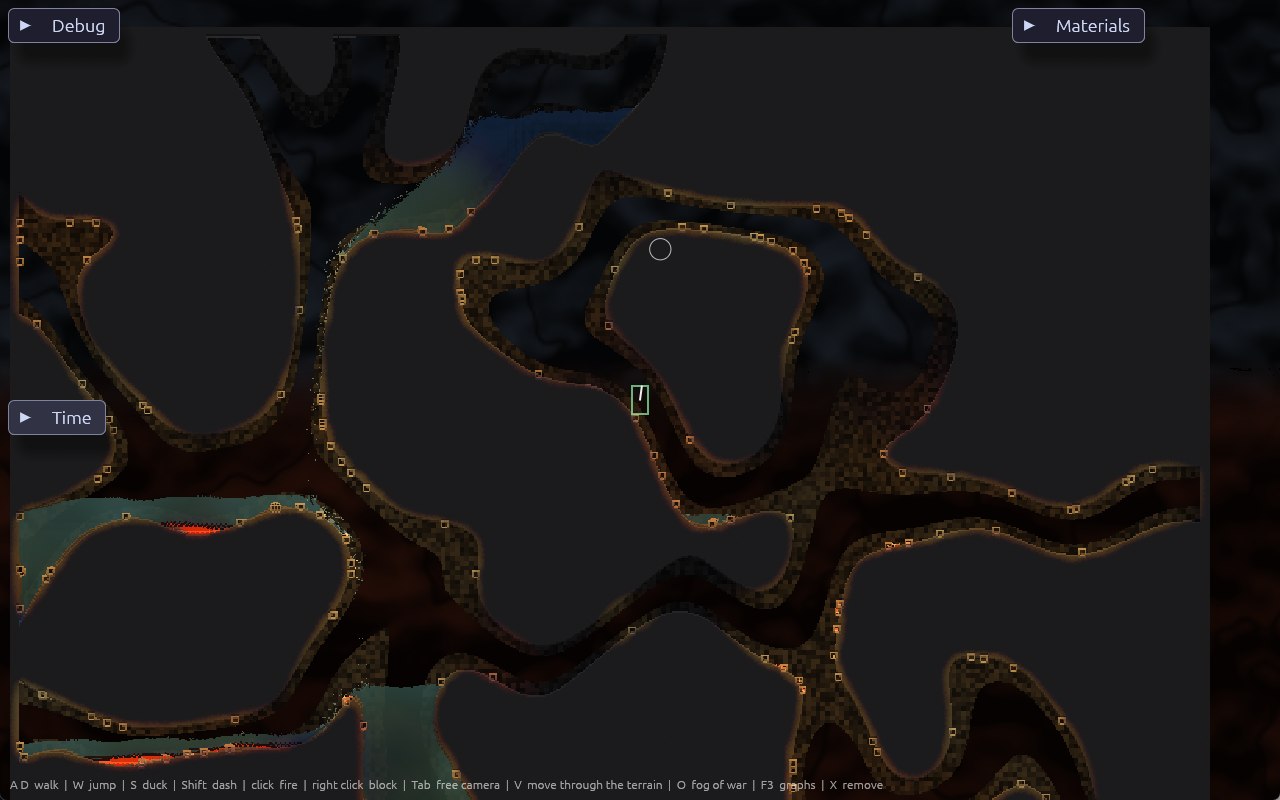
This one is a passion project. I've been working on it on and off for years, and it comes out of three games. Noita, where every pixel of the world is simulated. ROUNDS, where you take a card between rounds and the powers stack up. Soldat, for fast 2D multiplayer that doesn't take itself too seriously. I wanted the three of them in one game.
The game is sixteen players on a map they can take apart. You fight, the terrain comes down around you, and between rounds everybody picks a card that changes what their gun, shield or body can do. The cards stack, so a match escalates until it stops making sense. Free-for-all or teams, voice chat, and mods.
Every pixel of that map is a simulated cell instead of a picture of one. Sand falls and heaps up, water runs downhill and finds its level, fire spreads through wood and goes out when it runs out of air, acid eats what it touches. None of it is scenery. If you can see it you can destroy it, and it behaves sensibly while you do.
A match
Rounds are short. You drop into a cave or a structure, and by the end of one it doesn't look much like it did at the start, because sixteen people have been shooting at it. Nothing gets rebuilt in between, you play the wreckage you made.
Progression is one shared deck for the whole match, picked by the host before it starts. Between rounds each player gets offered five cards at random and takes one. Cards a player takes come out of the deck for everyone, cards nobody takes go back in. The player with the fewest round wins picks first, and whoever won the last round doesn't pick at all.
The deck shrinking is the point. Rare cards get likelier the longer a match runs, and taking one is also the only way to stop someone else having it.
Where it actually is
Milestone one, which is the simulation and the sandbox I tune it in. Materials, movement, reactions, the temperature and charge layers, cave generation, world streaming and rigid bodies are written. The game on top of them is not. Right now it's an engine, not something you can play. It's closed source too, so there's nothing to link yet.
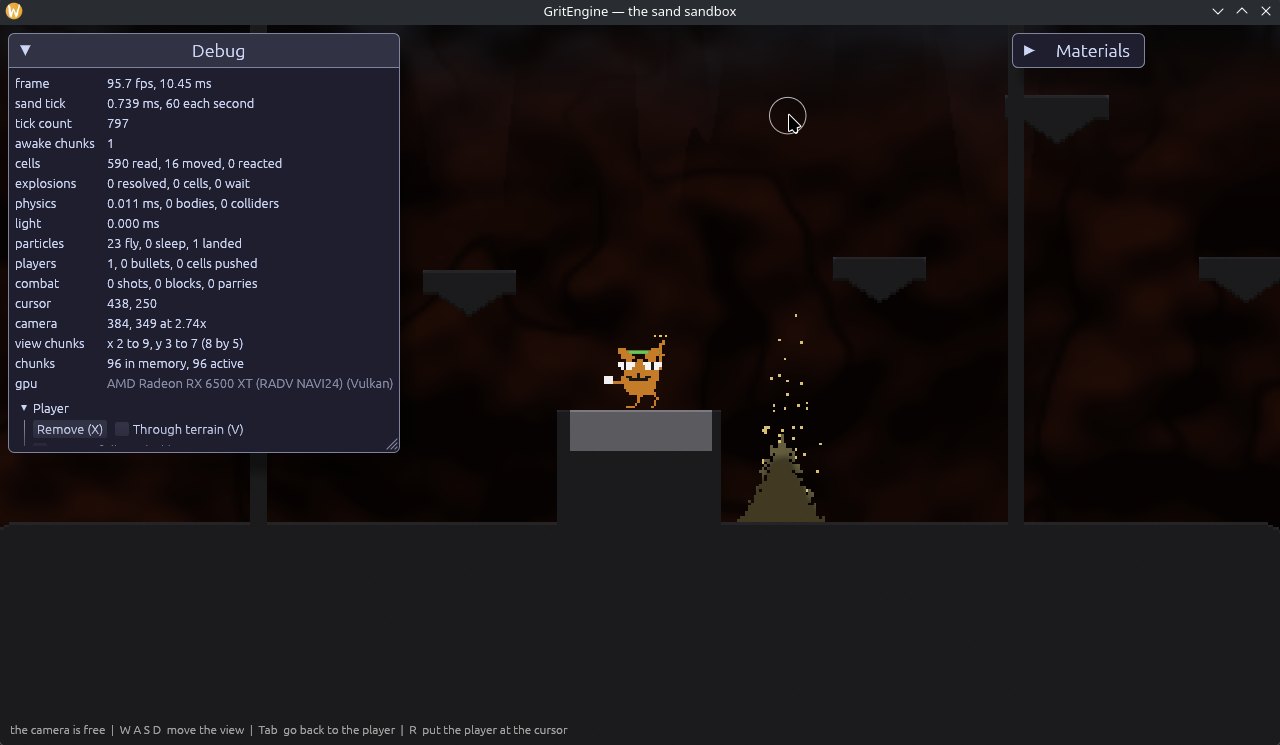
The screenshot at the top is the sandbox mid-test. The map border is set to hurt, lava is coming in along the top edge, and the word Friends is drawn into the map in sand so I could watch it come apart.
This is also the second start. The first one got to about 18,400 lines of Rust with no gameplay code in it at all. The simulation is the fun part to write, so I kept writing it, and every time I got close to gameplay I found another thing in the sim worth doing properly. Eventually I had a very good falling sand engine and no game. I kept the design documents, which were the part actually worth keeping, and started the code again from the bottom.
That is the outcome, and it is not a flattering one. The lesson I actually took from it is that a project with no one waiting on it will drift toward whatever is most interesting to build, and the only fix is a deadline or a user. Everything else I work on now has one of the two.